
Poor people…
Aurelio Porfiri

Today, on Ash Wednesday, I happened to attend a funeral.
This funeral concerned my barber.
This gentleman, who was 87 years old, had been the barber in my neighborhood for perhaps 50 years; so he had seen me grow up, and he had seen many other people grow up as well.
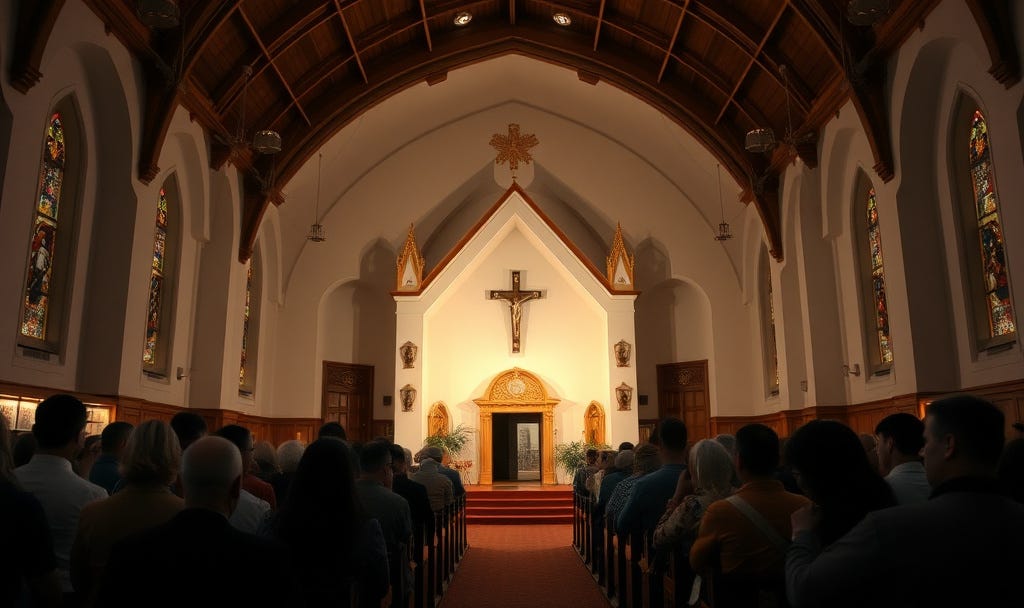
When such a person, a real point of reference in the neighborhood, dies, one naturally expects that many people will attend his funeral. The ceremony was held in the parish church, a marvelous church here in the center of Rome.
In fact, there were many attendants from the people — note this word “people,” it is very important, and you will understand why.
Personally, I was very struck by the fact that the people attending this funeral were completely disconnected from any real understanding of what was happening during the Mass. There was an enormous lack of liturgical formation: people remained seated when they should have stood, or stood when they should have been seated. During the readings and the Gospel, some were looking at their phones, others were chatting.
It truly felt as though these people had attended a liturgy after many, many years. And perhaps that was indeed the case: these were people who entered a church only for funerals and weddings. I do not believe they had any regular contact with the liturgical life of the Church beyond these sacraments.
They were truly from the people — the very people who once formed the most fruitful base for participation in the sacraments.
All of them had nevertheless been formed in the new Mass, the very Mass that we were told was designed precisely for the people — that people I asked you to remember.
Yet this people seem not to have understood this gesture on the part of the Church. In fact, I believe there has also been a manipulation of the liturgy itself under the pretext of the people. I have been saying for quite some time that those responsible for the liturgy — at least some of them — truly do not understand the people for what they are.
They thought that by changing the rite, the people would sing everything, read everything, understand all the readings and the homilies. But this is not so.
The people — who possess important values, and of whom I am a part (I am a son of the people, so I am not speaking of something foreign to my own formation) — the people, I say, have their own way of relating to life and to religion.
I believe the Church once understood this very well, when she ensured that the liturgy was objective and radiant with beauty. This beauty was enjoyed by everyone: the people as well as the higher and more affluent classes. The Church also made sure that the people had their own particular moments, such as in devotions — devotions that today have been almost set aside.
And yet these were important moments in which that special popular disposition could find proper expression.
Instead, it was thought that by bending the rite to the perceived level of the people, they would be much more inclined to participate enthusiastically. But in reality, this is not so. One must also understand that those who likely directed the liturgical reform may themselves come from the people, yet they have certainly forgotten the people’s expectations, character, and even their limits.
We must not conceal that people who do not choose to pursue a particular intellectual education certainly possess important and even profound values; however, one cannot ask of them what they do not understand, cannot understand, or do not wish to understand.
What I believe was once the Church’s pedagogy was to meet these people in certain ways, while still safeguarding the beauty, objectivity, and importance of the liturgical rite for what it is — not for what might please a particular social category.
I think this reflection is very important. It is important because the sense of the liturgy has been distorted, not only aesthetically, and because there has been a profound misunderstanding of what the people truly are.
The people have their own simplicity, which is also something beautiful. But if we reflect: if we invite people from so-called popular categories to a museum, we certainly would not replace the paintings with less complex works in order to please them. What can be done — as the Church once did — is to explain the Mass in its integrity and beauty.
In the end, this was also the original aim of the liturgical movement: to bring the people closer to the Mass. It is important to bring the people closer to the Mass, not to bend the beauty of the Mass down to our level. For this would be a great loss, not only for the rite itself — as we can witness in many of our churches — but above all for us.
Very well stated. How do we as a Church recover?